
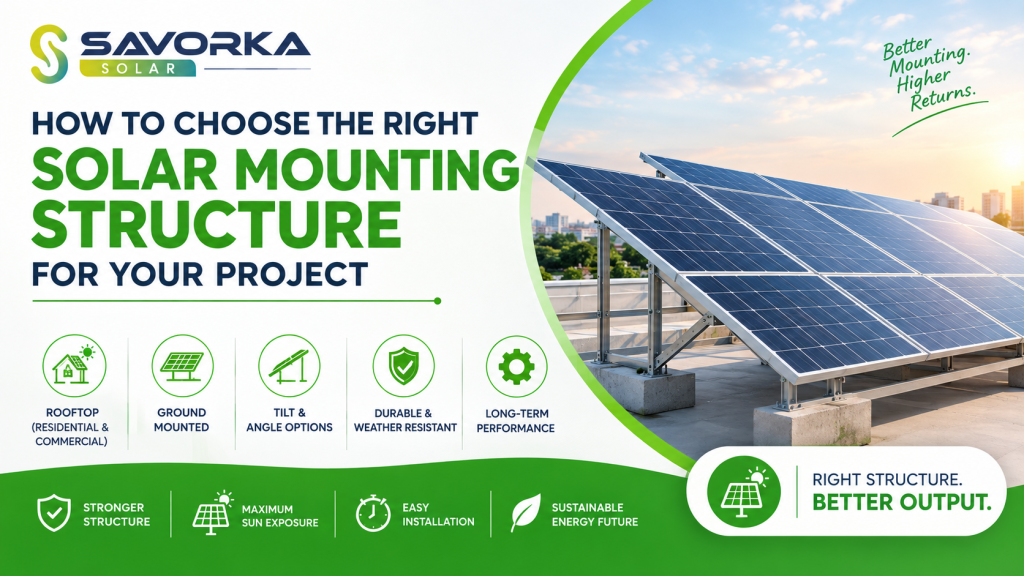


Whether you are planning a residential rooftop installation, commercial project or large ground-mounted solar plant, selecting the right solar mounting structure depends on several technical and site-specific factors.
What Is a Solar Mounting Structure?
A solar mounting structure is the framework used to securely install solar panels on a roof, ground or another suitable surface.
It transfers the weight of the solar modules and structural loads to the supporting surface while helping maintain the required panel orientation.
Common applications include:
- Rooftop solar systems
- Ground-mounted solar plants
- Commercial and industrial rooftops
- Open-land solar projects
- Special-purpose solar installations
The structure should be designed according to the project’s location, panel configuration, environmental conditions and installation surface.
1. Start With the Installation Site
The first consideration is where the solar panels will be installed.
For rooftop projects, the structure needs to match the roof type and its existing construction. A structure suitable for a concrete roof may not be appropriate for a metal sheet roof.
For ground-mounted projects, factors such as soil condition, terrain, available land and foundation requirements become more important.
A proper site assessment helps determine the appropriate structural design before manufacturing and installation.
2. Choose the Right Structure for Your Roof
Different roofs require different mounting approaches.
RCC Roofs
Concrete or RCC rooftops are commonly used for residential and commercial solar installations. Structures can be designed with suitable foundations or other approved mounting methods depending on the roof and project requirements.
Metal Sheet Roofs
Industrial and commercial buildings often have metal roofs. The mounting system must be compatible with the roofing profile while maintaining structural stability and preventing unnecessary damage to the roof.
Ground-Mounted Systems
Ground-mounted solar structures are installed on foundations fixed into the ground. They are commonly used for larger solar projects where sufficient land is available.
The correct choice depends on site conditions rather than simply selecting a standard structure.
3. Consider Wind and Weather Conditions
Solar structures remain exposed to outdoor conditions throughout their operating life.
Wind loading is particularly important because solar panels present a large surface area. The mounting structure must therefore be designed to withstand the wind conditions applicable to the project location.
Rain, humidity, temperature variations and other environmental conditions should also be considered.
A properly engineered structure reduces the risk of movement, deformation or premature deterioration.
4. Pay Attention to Material Quality
The material used for the mounting structure directly affects its durability.
Steel is widely used for solar mounting structures because of its strength and suitability for larger installations. Protective coatings such as galvanization can help improve resistance against corrosion.
When comparing suppliers or solar structure manufacturers, businesses should consider:
- Material specifications
- Structural strength
- Corrosion protection
- Manufacturing quality
- Applicable design standards
- Expected service life
The cheapest structure is not necessarily the most suitable option if material quality or corrosion protection is compromised.
5. Check Panel Compatibility
The structure should be compatible with the solar modules being installed.
Panel dimensions, mounting points, module orientation and row spacing all affect the structural design.
A well-designed mounting system should allow panels to be securely fixed while providing appropriate access for installation and maintenance.
It is therefore better to finalize the structure after considering the actual solar modules and project layout rather than selecting a structure independently.
6. Consider Tilt and Orientation
The mounting structure determines how the solar panels are positioned.
For rooftop systems, the available roof area may limit the orientation or tilt that can be achieved. Ground-mounted systems generally offer greater flexibility in arranging panel rows.
The design should balance solar exposure with structural stability, available space and maintenance access.
There is no single tilt angle that is ideal for every project. The appropriate design depends on the project’s geographical location and system layout.
7. Think About Installation and Maintenance
A good mounting structure should make installation straightforward while allowing technicians to access the panels and other system components when maintenance is required.
Adequate spacing between rows and suitable access paths are particularly important for larger ground-mounted and commercial installations.
The structure should also avoid unnecessary obstruction of drainage paths on rooftops.
Considering maintenance during the design stage can make future inspection, cleaning and component replacement easier.
8. Work With Experienced Solar Structure Manufacturers
For larger commercial, industrial and ground-mounted projects, the mounting structure should be engineered specifically for the site rather than treated as a generic component.
Experienced solar structure manufacturers can evaluate project requirements such as panel configuration, wind conditions, foundation requirements and installation surface before finalizing the design.
This is especially important for projects where structural performance and long-term durability are critical.
Common Mistakes to Avoid
When selecting a solar mounting structure, avoid making the decision based only on price.
Some common mistakes include:
- Using the same design for different roof types
- Ignoring local wind conditions
- Choosing poor-quality or inadequately protected material
- Not checking panel compatibility
- Leaving insufficient maintenance access
- Using a standard design without proper site assessment
A small saving during installation may create additional costs later if the structure requires repairs or replacement.
How Savorka Solar Can Help
Savorka Solar provides solar solutions for residential, commercial, industrial and ground-mounted projects. The mounting structure is considered as part of the overall system design rather than as a separate afterthought.
From site assessment and structural planning to solar panel installation, the right approach can help create a system that is secure, practical and suitable for long-term operation.
If you are looking for reliable solar structure manufacturers or planning a rooftop or ground-mounted solar project, Savorka Solar can help evaluate your site and project requirements.
Final Thoughts
The right solar mounting structure depends on more than the size of the solar system. Roof type, site conditions, wind loads, material quality, panel dimensions, orientation and maintenance requirements all influence the final design.
Choosing a properly engineered structure from an experienced manufacturer can help protect the solar investment and support reliable system performance over the long term.
Planning a solar project? Talk to Savorka Solar for a mounting structure and solar solution designed around your site requirements.
FAQs
1. What is the best material for a solar mounting structure?
Steel is widely used for solar mounting structures because of its strength. Corrosion protection, such as suitable galvanization, should also be considered depending on the project environment.
2. Can the same mounting structure be used on every roof?
No. RCC, metal sheet and other roof types can have different structural and installation requirements. The mounting solution should be selected based on the specific roof.
3. What should I check before choosing a solar structure manufacturer?
Consider material quality, corrosion protection, structural design, manufacturing standards, project experience and the manufacturer’s ability to customize the structure according to site requirements.
4. Are mounting structures important for ground-mounted solar plants?
Yes. Ground-mounted structures must account for factors such as soil conditions, foundation design, wind loads, terrain and panel layout.tion design, wind loads, terrain and panel layout.